Shasta—Aravis
The Horse and His BoyShasta—Aravis is a relationship that moves from suspicion and condescension toward respect through a decisive act of courage. At first Aravis is willing to travel with Bree and Hwin but questions whether Shasta can be trusted; after he risks himself to help her, she admits that she had misjudged him and urges the others to make amends rather than return to Calormen.
First Impressions and Distrust
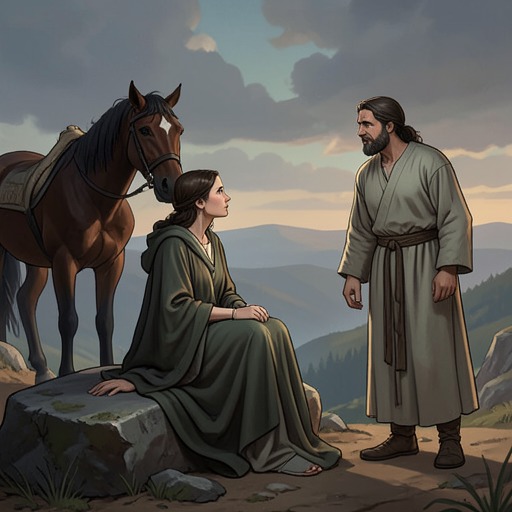
When the travelers consider whether to continue together, Shasta objects to Bree’s insistence that the two humans join them. He tells Bree to let Aravis and Hwin go their own way, convinced that they do not want his company. Hwin contradicts that assumption, but Aravis’s answer confirms that her reservations are specifically about Shasta: she says she does not mind traveling with Bree, then asks how she can know that the boy is not a spy.
Shasta hears her question as evidence of a deeper judgment. He protests that she might as well say she considers him unworthy of her. The exchange establishes a sharp difference in how they understand the situation: Aravis frames her doubt as a reasonable precaution, while Shasta experiences it as a judgment of his worth. Their eventual agreement to travel together does not immediately resolve the distance between them; Aravis says nothing to Shasta and plainly prefers Bree’s company.
Bree’s Vouching and Shasta’s Response
Bree answers Aravis’s suspicion by vouching for Shasta. He says that the boy has been true to him and a good friend, and judges him to be either a Narnian or an Archenlander. This endorsement wins Shasta a place in the group, but it does not itself establish trust between Shasta and Aravis. Their shared journey begins under Bree’s protection, with Aravis still keeping her preference for Bree evident.
Shasta’s complaint also reveals how much the rejection matters to him. Rather than treating Aravis’s suspicion as a neutral question, he takes it personally and challenges the implied hierarchy between them. The friction is not settled by argument. It is changed later, when his actions give Aravis grounds to revise her judgment for herself.
The Lion Attack and the Turn in Their Relationship
During the lion attack, Shasta is riding ahead with Bree when he calls for the horse to stop and go back to help. Bree does not hear or understand him, according to Bree’s later account. Shasta therefore acts without the support of his companion: he slips his feet from the stirrups, swings both legs over the left side, hesitates for a fraction of a second, and jumps from the horse.
The leap hurts him badly and nearly leaves him winded, but he staggers back toward Aravis before he has time to dwell on the pain. She is stooping low over Hwin’s neck and appears to be trying to draw her sword. As the lion attacks her, Shasta has no weapon—not even a stick or stone. He nevertheless lurches toward it and shouts at it to go home. The lion checks its charge and rushes away. Shasta’s intervention does not arise from a carefully prepared plan: he has never done anything like it before and hardly knows why he is doing it. Its force lies in the choice itself, made while Aravis is in immediate danger.
Recognition and Apology
Afterward, Bree contrasts Shasta’s conduct with his own. Bree had called himself a war horse and boasted of his fights, yet Shasta, a boy who had never held a sword, ran back while the others fled. Aravis recognizes the same reversal in their relationship. She says that she had been snubbing Shasta and looking down on him, but that he had proved the best of them all. Her response does not erase the earlier insult; it names it and acknowledges the evidence that has made her change her view.
Aravis proposes that they stay and say they are sorry rather than go back to Calormen. The proposal makes reconciliation a practical choice: respect must be followed by an attempt to repair the relationship. Her praise concerns what Shasta did when danger came, not his birth or standing. The qualities she had implicitly doubted—his courage and his worth as a companion—are established by the moment in which he turns back for her.
Significance
The relationship’s change is carried by an action rather than a speech of self-defense. Shasta initially protests that Aravis thinks him beneath her, but the decisive answer is his unarmed return to help her. Aravis, in turn, is not simply made to accept Bree’s earlier endorsement; she recognizes her own conduct and suggests an apology. Their movement from mistrust to respect thus depends on both a demonstrated act and an honest acknowledgment of prior condescension.
The reversal also unsettles the group’s assumptions about courage. Bree’s boastful image of himself as a battle-tested war horse is measured against Shasta’s spontaneous risk, and Aravis’s assessment follows the same contrast. At this point the supplied narrative establishes a willingness to apologize and a new regard for Shasta; it does not provide a further account of how their relationship develops after that decision.